Seaweed, reconsidered.
More than 70% of what's on a supermarket shelf contains some derivative of seaweed. A look at the history, biology and design potential of the ocean's most under-sold resource.
The milky seas mystery
In January 1864, the Confederate warship Alabama was sailing southwest off the Horn of Africa when it passed, as its captain Raphael Semmes recorded, "from the deep blue water in which we had been sailing, into a patch of water so white that it startled me." Sailors had been reporting these "milky seas" for well over a century, and it took almost as long after Semmes's own sighting before anyone could explain them. The answer turned out to be algae: colonies bloom and die on the surface, their ruptured cells release lipids that bacteria feed on, and those bacteria multiply until they're dense enough to glow continuously across miles of open ocean. Several species of bioluminescent microalgae can produce this effect, alongside a range of other marine organisms that glow for their own reasons.
I'm writing this after a year spent immersed in seaweed as a material, first at the Rhode Island School of Design and then at the RISD Nature Lab, and that story is where my own curiosity about it started too.
A Victorian obsession
Seaweed has had its moment before. In the mid-1800s, around the same time Charles Darwin was popularizing a broader public interest in natural science, seaweed collecting became a genuine Victorian pastime: a way to explore nature, build scientific literacy, and bring home an attractive keepsake. By the 1840s several identification and preservation guides were already in print, including Anna Atkins's Photographs of British Algae, widely considered the first book of photography ever published. Atkins pressed seaweed specimens directly onto light-sensitive paper to produce cyanotype prints, a negative image for each species.
Plant, animal, or neither?
So is seaweed a plant or an animal? The honest answer is neither, and the question itself is a little bit of a trick. "Seaweed" is an informal catch-all for a huge range of marine algae, most of which sit in the kingdom Protista rather than Plantae. There are more than 30,000 known species, with the real number likely in the hundreds of thousands once everything still undescribed is counted, and land plants are themselves theorized to have evolved from algae that moved inland from the coasts.
Algae are typically grouped by color. Brown seaweed grows mostly in cold water near the coastline, usually anchored to a rocky seabed, though some species like sargassum form vast free-floating rafts, and giant kelp can grow up to 200 meters long. Red seaweed ranges from the cold waters of Northern Europe to tropical coral reefs, often on rocky shores exposed at low tide. Green algae, including the "sea lettuce" common on rocky shores, is found in aquatic environments worldwide. A separate way to classify algae is by size: microscopic, unicellular phytoplankton that covers vast stretches of open ocean, versus the macroscopic, multicellular organisms we actually harvest and call seaweed.
Hidden in almost everything
Our use of algae is so widespread that it's genuinely hard to go a day without touching it in some form: food, cosmetics, pharmaceuticals and agricultural fertilizer all depend on it. More than 70 percent of packaged food on a supermarket shelf contains a seaweed derivative, including ice cream, toothpaste, cookies and beer. The extract doing most of that work is algin, pulled from brown algae. As a stabilizer it keeps gravies, soups and sauces from separating; as an emulsifier it blends oil and vinegar in salad dressing, and gives pet food its texture. Because it's a foaming agent, it also helps beer hold its head.
Algin's pharmaceutical uses are just as varied: a binding agent in tablets that also helps them disintegrate in the stomach, a demulcent in throat lozenges, and a protective coating in antacids. A specific form, calcium alginate, is used in wound dressings, where its absorbent fibers create a moist healing environment and rinse away cleanly with saline. In manufacturing, algin thickens textile dyes for more precise color application (the textile industry alone accounts for roughly half of global algin use), stabilizes paint pigments, coats paper for a smoother finish, gels face masks, and keeps lipstick smooth on the lips.
How seaweed actually works
Seaweed evolved its own specialized cells to survive without ever becoming a plant. Nearly all of it arranges its cells into flat blades to maximize sunlight exposure. Many species grow holdfasts, root-like structures that anchor them to rock, and some grow stalks that function like a stem. Some produce hollow, air-filled floats, or a single gas-filled pneumatocyst beneath the blade, that keep the organism near the sunlit surface. But none of it has a vascular system to move food and water internally; every cell photosynthesizes and feeds itself, which is precisely why biologists classify algae separately from true plants despite the superficial resemblance.
That biology has useful side effects. Algae store energy as natural oils that, under the right conditions, can be converted into biofuel for cars, trucks, trains and planes. The same bioluminescence from the milky-seas story comes from a chemical reaction between the enzyme luciferase and luciferin: oxygen oxidizes the luciferin, luciferase speeds the reaction, and the excess energy is released as light rather than heat.
Kelp forests and the food web
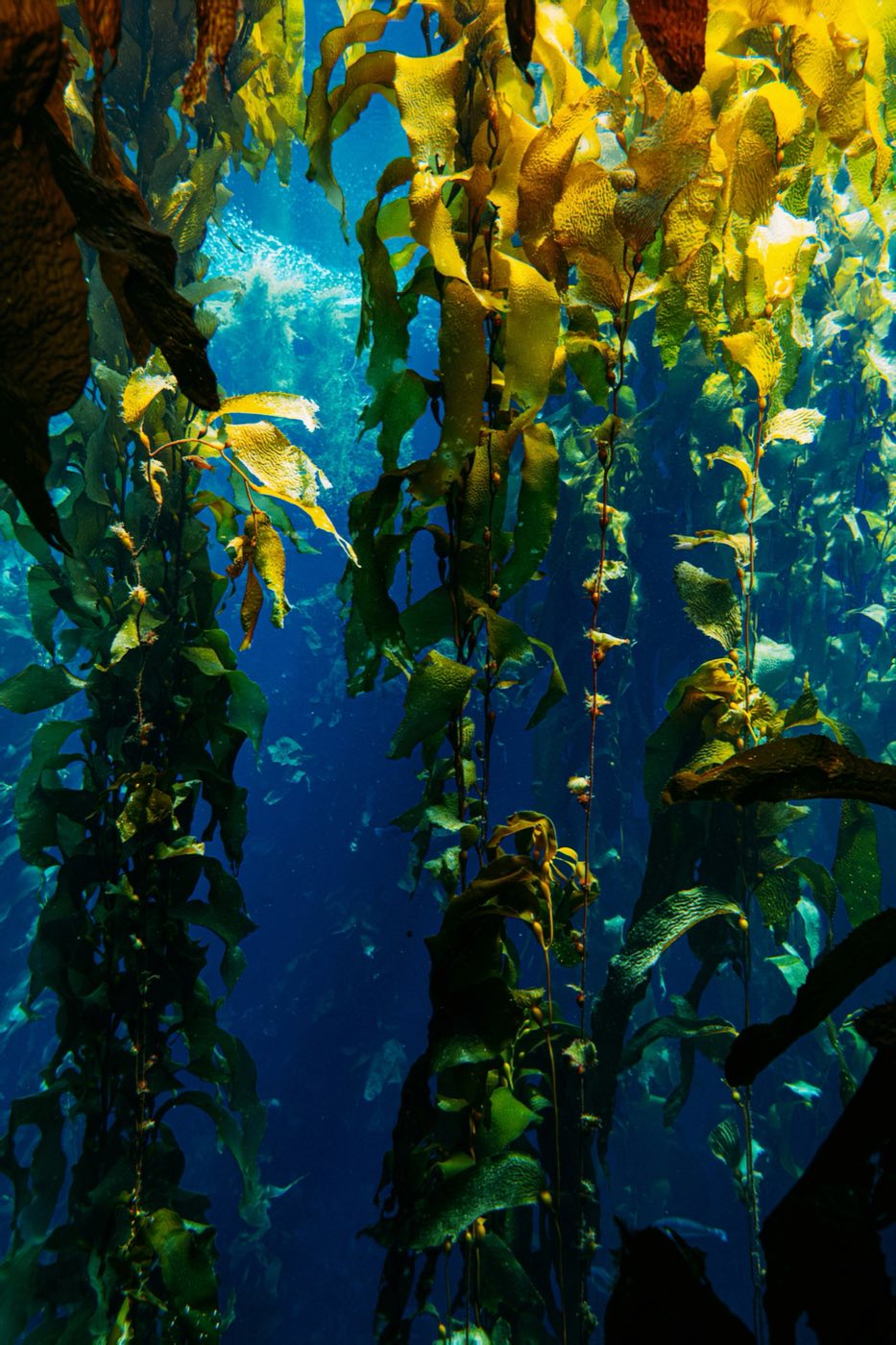
Large brown algae function as shelter and substrate for an entire ecosystem: bottom-dwelling animals, epiphytic algae that grow on other algae, and numerous fish, invertebrates, birds and mammals. Species like kelp form vast underwater forests that offer spawning grounds and nurseries, growing upward through the water column 20 to 30 meters to spread their blades toward the light, often shading out whatever grows beneath into its own understory layer. Growth rates can be extraordinary: 6 centimeters a day has been recorded in bull kelp, and Macrocystis pyrifera off the California coast has been measured growing 50 centimeters a day. In a strange testament to how adaptable this ecosystem is, kelp has even been observed colonizing discarded fishing nets, one of the largest sources of ocean plastic, forming entire micro-biomes around them.
Phytoplankton and seaweed sit at the base of the marine food web, consumed by zooplankton, small fish and crustaceans, which are in turn eaten by larger fish, small sharks, corals and baleen whales, up through apex predators like large sharks, billfish, dolphins, toothed whales and seals. Humans draw from every link in that chain.
The ocean's carbon advantage
When the Amazon fires drew global attention a few years ago, the phrase "lungs of the earth" stuck for good reason: the Amazon's 6 to 8 million square kilometers of forest plays a genuinely vital role in removing carbon dioxide from the air. But between 1994 and 2007 alone, oceans absorbed an estimated 34 gigatons of carbon through algae, vegetation and coral, more than comparable estimates for the Amazon's own carbon absorption over the same period. Trees alone will not save us from the current crisis; the ocean plausibly can do more.
Algae can be used in a number of ways to cut atmospheric carbon, and storing it is only the most direct one. It's also readily converted into other sustainable products, from tennis shoes to steel alternatives to veggie burgers. Where a tree sequesters carbon by growing wood, algae does it by growing more algae, and it can outcompete trees on raw capture per unit area: it covers more surface, grows faster, and can be cultivated at a density in bioreactors forests simply can't match.
When algae turns harmful
Not all algae blooms are harmless, and climate change is making the harmful kind more common. Toxic blue-green algae thrive in warm, slow-moving water, and several mechanisms compound as the water warms: heat prevents mixing, letting algae grow thicker and faster; warmth makes it easier for algae to float to the surface; and algal blooms themselves absorb sunlight, warming the water further and encouraging more blooms. Climate-driven drought can make freshwater saltier, letting marine algae invade freshwater ecosystems, which has been killing fish in southwestern and south-central U.S. lakes since 2000. Higher atmospheric and water carbon dioxide levels feed rapid algae growth directly, and shifting rainfall patterns, more drought punctuated by more intense storms, drive the nutrient runoff that feeds further blooms.
Scaling the harvest
Seaweed used to be harvested almost entirely from the wild; today the large majority is farmed, typically on ropes or nets at sea, or in land-based tanks and ponds. Farmed production nearly doubled between 2005 and 2015, from 13.5 to 29.4 million tonnes a year, dwarfing the roughly one million tonnes still harvested from wild stocks annually. A parallel microalgae industry is growing in land-based tanks and biorefineries, increasingly at industrial scale.
Photobioreactors, controlled artificial growth chambers with managed temperature, pH and nutrient levels, are one of the more promising cultivation tools: they can run on wastewater unsuitable for human use, minimize evaporation, and, with added iron, magnesium and vitamins, reach the highest photosynthesis and carbon-capture rates of any cultivation method, while avoiding the pollution risk of open-ocean blooms. Their main drawback is upfront cost. Building and maintaining them is still too expensive to be reliably economical, and because most of that cost is incurred during construction, nobody has yet accumulated enough operating history to make a confident long-term cost-benefit case.
Reorienting coastal communities
Most of us have built our lives around living inland, but there's a real question in whether communities could reorient around coasts instead, given how much common ground seaweed shares with land plants. Seaweeds are rich in fiber, calcium, folic acid, iodine and vitamin K, and have fed, clothed and fertilized coastal communities for thousands of years; studies link regular consumption to lower blood pressure and better digestive health, which is part of why it's trending as a superfood, especially across Europe. That rising demand cuts both ways: without good management, seaweed cultivation can alter water quality and disrupt local ecosystems, since it requires large areas that don't naturally host it.
Like land plants, seaweed sequesters carbon dioxide into biomass through photosynthesis, and it grows fast enough to do this at a genuinely useful rate. Once captured, that carbon can be harvested for use, or left to sink to the seafloor where it originally came from. Scientists have spent the last two decades assessing exactly how much seaweed aquaculture could do for the climate if scaled up, but the market for it barely exists yet. Someone first has to be willing to pay to store carbon in seaweed, and government policy needs to actively support the industry rather than leave it tripping over regulations that were never written with aquaculture in mind. Zoe Lee, co-founder of SCUP Aquaculture in Rhode Island, points to a less obvious bottleneck: a straightforward competition for ocean space between seaweed farms and offshore wind turbines. As she put it, the real challenge is "navigating organizational and community needs to have a system for multi-use of resources."
Designing with seaweed
None of that diminishes the design opportunity. During a graduate studio at RISD, I worked on a seaweed packaging project that treated this fast-growing, genuinely regenerative resource as a serious material platform rather than a novelty ingredient, work I was later glad to share at a Brown-RISD Innovation Community talk. The chemistry behind it is already well understood. What's missing is the farming and processing capacity, and a policy environment willing to fund it, to get there at scale.