Wetlands & blue carbon.
Mangroves can store up to five times the carbon of a tropical forest. They're also disappearing at up to 980,000 hectares a year. What it would actually take to turn protection into a market.
Why this matters
Wetlands are among the highest-density carbon stores per hectare on Earth, holding carbon in both living biomass and deep, long-lived soil. Protecting and restoring them prevents large CO₂ releases and delivers immediate co-benefits to the people living alongside them, which makes this one of the few climate solutions that's both a near-term and a long-term bet with proven social returns.
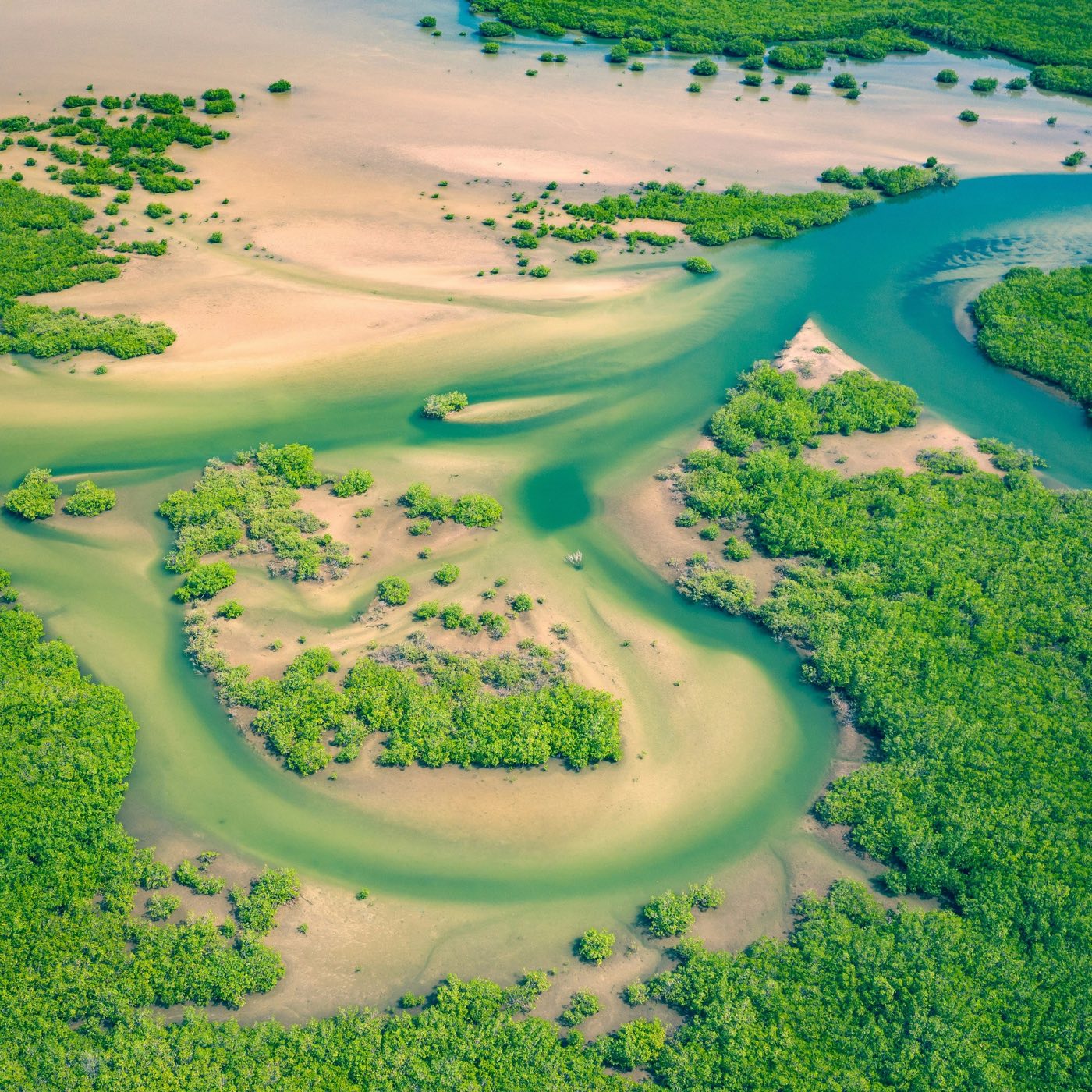
Mangroves, seagrass meadows and tidal marshes do a disproportionate amount of work for how little attention they get: protection from storms and sea-level rise, prevention of shoreline erosion, regulation of coastal water quality, habitat for commercially important fisheries and endangered species, and food security and resilience for hundreds of millions of coastal people worldwide. The carbon these ecosystems capture is called "blue carbon," and there's a lot of it. Because the plants grow quickly and decomposition is slow in waterlogged, low-oxygen soil, mangroves can store up to five times the carbon of an equivalent tropical forest.
The scale of the loss
Despite those services, coastal wetlands are among the most threatened ecosystems on Earth, with an estimated 340,000 to 980,000 hectares destroyed every year. Globally, up to 67% of mangroves and at least 35% of tidal marshes and 29% of seagrass meadows have already been lost. If current trends continue, a further 30–40% of remaining marshes and seagrasses, and nearly all unprotected mangroves, could be gone within the next century. When these ecosystems are degraded or lost, they don't just stop absorbing carbon, they become active sources of it, releasing CO₂ back into the atmosphere and creating scarcity in the surrounding bio-region.
The climate math
Blue carbon isn't a substitute for fast, deep cuts to fossil fuel use, which still matter more for keeping warming under 1.5–2°C. But it's a genuinely high-value, high-co-benefit, nature-based climate solution, and in many countries it's more cost-effective than engineered carbon removal, while also delivering climate resilience and real economic value on the side.
Per area, wetlands commonly sequester 6–8 tonnes of CO₂-equivalent per hectare per year, on top of soil carbon stocks that have accumulated over centuries, and protecting that "hydric" soil avoids the large one-time emissions spike that comes when a wetland is degraded or lost. At the global scale, conservative synthesis estimates suggest that restoring and protecting coastal vegetated wetlands could add roughly 0.6 to 0.84 gigatonnes of CO₂-equivalent per year by 2030 under ambitious restoration scenarios, on the order of 1 to 3 percent of current annual fossil CO₂ emissions. That's a meaningful near-term contribution to climate action while the harder work of decarbonizing energy and transportation continues elsewhere.
Why it's hard to scale
There's significant uncertainty and no standardized, reliable methodology yet for measuring and verifying how much carbon a given wetland actually stores and keeps stored. That gap compounds into several concrete barriers. Measurement is the first: wetland soil carbon is deep and highly variable, which makes it complex and expensive to quantify reliably, and that uncertainty undermines investor confidence, the credibility of carbon credits, and even national emissions inventories, while raising the risk of over-crediting and reversals.
Governance is the second barrier. Many wetland areas overlap communal, Indigenous, or otherwise ambiguous land tenure, and short-term economic drivers like farming and development, combined with weak governance, are what actually drive most wetland loss. Without secure rights and real local sovereignty over these areas, restoration efforts are vulnerable to being captured by outside actors, or simply fail before they can take hold.
Pricing and transparency are the third. A lack of clear economic data and shared understanding of what actually drives project costs makes it difficult to set blue-carbon credit prices that are both fair and justifiable, which in turn discourages investment and leaves the gap filled by philanthropic funding rather than a durable market.
What could actually work
The first lever is standardizing and funding long-term monitoring, reporting and verification (MRV): scientific protocols that combine field sampling, hydric soil cores, satellite and remote sensing, and citizen science, backed by multi-year baseline studies and permanence bonds that underwrite the risk of a project reversing later. Projects that already use standardized MRV with long monitoring windows are consistently more likely to secure high-integrity carbon credits and public financing, a pattern documented by the Blue Carbon Initiative.
The second is centering community and ecology directly: securing legal tenure or community stewardship agreements, and structuring benefits, marine planning, aquaculture enhancement, payments for ecosystem services, restoration jobs, so that local communities actually capture the revenue. Community-run programs, like the Village Mangrove Councils in Tamil Nadu, India, show measurably higher survival rates and lower illegal encroachment than top-down alternatives.
The third is blending public finance with carbon markets: grants to cover initial MRV and pilot restoration costs, paired with results-based blue-carbon finance backed by real data, verification processes, and social-equity safeguards that lower risk for investors while protecting the people and ecosystems involved. The Carbon to Sea Initiative estimates this approach could eventually sequester carbon for as little as $25 a tonne.
Who this has to work for
None of this works, ecologically or ethically, without tenure and benefit-sharing: Indigenous peoples and local coastal communities need legal control or genuine co-management of mangrove resources, and a fair, transparent share of any revenue those resources generate. Projects that skip this risk dispossessing the very people who've been stewarding these ecosystems, which tends to fail on both ecological and ethical grounds. A portion of every blue-carbon revenue stream, from carbon markets and wetland services alike, needs to flow back into community livelihoods, fisheries co-ops, eco-tourism, and a standing permanence reserve.
The honest framing here is that the scale-up potential is simultaneously modest and powerful. Global blue carbon can't replace deep decarbonization, it's a few percent of emissions by 2030 even under optimistic scenarios, but wetland action buys real time by preventing large one-time emissions from conversion, while delivering resilient coastal protection and livelihoods at the same time. Done right, it's a rare triple win.