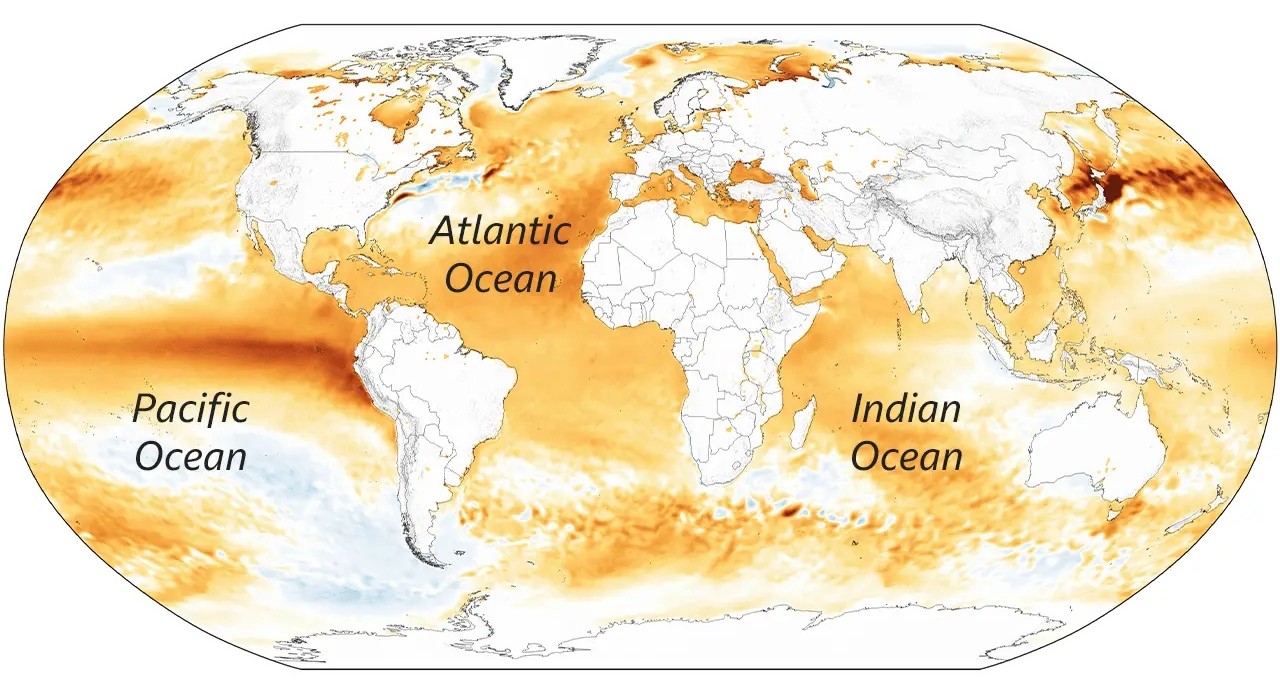
Ocean Warming Today

The oceans are warming at record temperatures each year.
The ocean covers over 70% of our planet's surface with an average depth of over 3,600m, and has absorbed more than 90% of the excess heat generated by human activity since industrialization. For decades, it has buffered us from the worst effects of a warming world. That buffer is now weakening, and it requires a combination of mitigation and adaptation efforts.
Researchers found that global average sea-surface temperatures (where the ocean water and atmosphere meet) in 2025 were the third-highest on record, and remained about 0.5°C (1°F) above the 1991–2020 average baseline. Some areas are warming faster than others: the warmest included the South Atlantic and North Pacific Oceans, and the Southern Ocean.
2025 was the third-warmest year on record for oceans in NOAA's global temperature record, which dates back to 1850. Today, while we see the blue economy grow, we also see record ocean warming across every basin, large-scale ice melt, rapid sea level rise, biodiversity loss and extreme weather effects.
These impacts are urgent threats to the health of our oceans, whose stability the global economy relies on, and more importantly, to the millions of species that inhabit Earth and call it home.